Capability · Sloping sites
Building on the blocks volume builders walk away from.
Engineered retaining, piled foundations, suspended slabs, terraced living. The work that turns a 1-in-3 hillside into a useful home rather than a structural liability.
Why sloping sites are different
A flat block is forgiving. A sloping block punishes every shortcut. The footings have to engage competent ground, which on Sydney sandstone often means deep piers or piling. Retaining walls become structural, not landscape. Access for materials and concrete pumps becomes a real cost line. Drainage has to be designed from the top of the block down, because every cubic metre of stormwater runoff finds the lowest point — which is your house. And the local council DCP usually has slope-specific controls (cut-and-fill limits, retaining wall height limits, tree retention zones) that an inland-default architect's first sketch rarely respects.
Foundation strategies for Sydney slopes
On Sydney sandstone sites — most of the Lower North Shore, parts of the Eastern Suburbs, Northern Beaches headlands — bearing rock is usually shallow enough to allow rock-anchored pad footings or stepped strip footings, which is the most economical option. On shale and clay sites, footings typically need to extend deeper to competent strata: bored piers (typically 450–900mm diameter, drilled to refusal) are the standard solution. On loose fill, alluvial, or steeply-sloping sites with marginal ground, screw piles or driven steel piles avoid the need for large rock-anchor anchorages. Suspended slabs spanning between piers are common on the steepest sites — they reduce the cut-and-fill volume, work with the natural slope, and allow services routing through the under-floor cavity.
Retaining walls — when they're structural, not landscape
Any retaining wall over about 1m tall in NSW needs structural engineering and council approval as a structure rather than a landscape element. Above 3m, it's a significant engineering project in its own right. Sydney slope sites typically use one or more of: gravity-mass walls (reinforced sandstone or concrete blocks, suitable up to ~1.5m); cantilever reinforced concrete walls (the workhorse, suitable to ~3m); soldier pile and lagging walls (steel posts with timber or pre-cast infill, suitable to ~5m); or piled walls with permanent ground anchors (used on cliff-edge and very tall retention). Drainage behind every retaining wall is non-negotiable — a wall that can't drain becomes a hydrostatic-pressure problem within one wet Sydney autumn.
Where sloping projects blow out
Underestimating site works is the universal failure mode. The architect designs a beautiful house; the structural engineer's first pass underestimates the retention; the builder quotes a competitive price assuming a 6m crane reach and ute access. Then the geotech report comes back at DD, the retaining wall doubles in scope, and the crane has to walk around the back lane because the front-yard slope can't take its tracking weight. We size the site-works budget realistically up front, not in variations. The second failure mode is drainage — every cubic metre of stormwater above the house has to be intercepted and discharged before it reaches the building, and that means engineered cut-off drains, agg-line collection, and properly-sized stormwater discharge to street or to a properly-detailed absorption trench.
How Varloch approaches sloping sites
Geotech first, design second. We've walked enough Sydney hillsides to know what the ground typically does — but a real bore log and a real structural engineer make the difference between a buildable design and an aspirational one. Site access is planned at the same time: where the crane sits, where the concrete pump parks, where the materials get craned in, what gets demolished or temporary-cleared to allow the build. The program builds in weather contingency because a partly-excavated hillside in a wet Sydney autumn is the difference between a project on track and a 6-week stop. And the director walks the site after major weather events to confirm cut faces, retention, and temporary drainage are doing what they were designed to do.
Frequently asked
What's the steepest slope you'll build on?
We've built on cross-falls up to about 1-in-2.5 (~22 degrees) with engineered retention. Beyond that, the structural and access costs typically dominate the project economics — feasible but worth a hard look at the brief first. The DCP for some Sydney LGAs (Mosman, North Sydney, Pittwater) restricts new development on slopes above 25%, so check the planning controls before committing.
Do sloping sites cost more than flat sites?
Almost always, yes. The site-works premium is typically 15–35% of the total build cost depending on slope, ground conditions, and access. The trade-off is usually views and amenity — which is why people build on slopes.
Can I have a level lawn on a steep block?
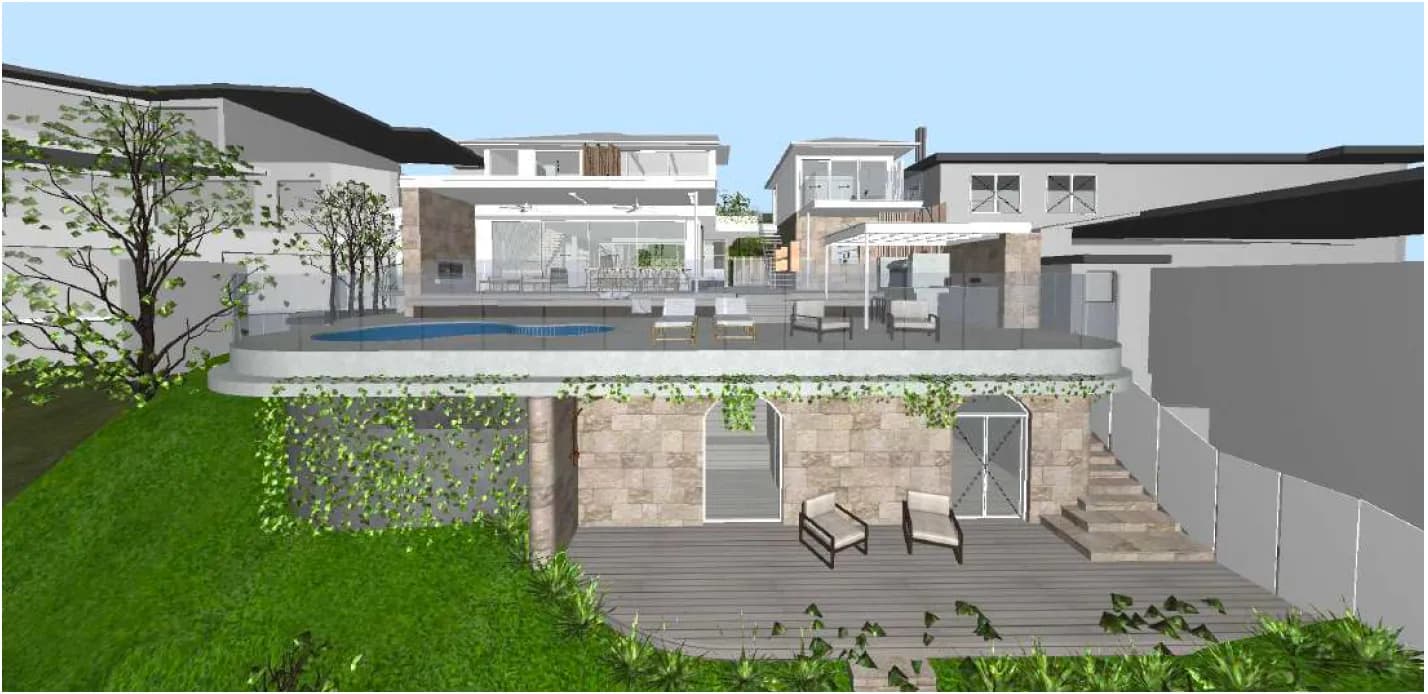
Yes — terracing and retaining can produce useful flat areas. Each terrace is a structural element that needs design and approval, so factor it into the DA and the budget. Council DCPs usually limit individual retaining wall heights (commonly 1.5–2m), so multi-step terracing with planted intermediate batters is the typical Sydney slope solution.
Will I need pile foundations?
Depends on ground conditions. Sydney sandstone areas often allow rock-bearing pads at modest depth. Clay and fill sites usually need piles or piers to reach competent strata. The geotech report is the answer. Bored piers (450–900mm diameter) are the most common Sydney solution; screw piles are increasingly used on access-constrained sites.
How do you get materials in and out on a steep block?
Crane location and access planning is a Day-1 conversation, not a mid-build problem. Common solutions: roadside crane positioning with extended reach; temporary access track from a neighbouring property (with agreement); helicopter lift for materials on the most extreme sites (rare, but we've done it for roof elements). Concrete is typically pumped — sometimes with multiple boom-pump stages on the steepest sites.
What about bushfire risk on a sloping site?
Sydney slope sites near bushland often trigger Bushfire Attack Level (BAL) classifications under AS 3959. A BAL-FZ rating significantly affects external materials, glazing, decking, and roof construction. The BAL assessment is part of the DA and the construction spec is non-negotiable once classified.
Can I add a swimming pool on a sloping block?
Yes, and it's often the cleanest way to use the lower terrace of a steep site. Suspended pools (cantilevered or post-tensioned over retained ground) are an option on the most exposed sites. Pool engineering on a slope is its own sub-project and adds 3–6 months to the program.
Working on something in this space?
Tell us about your site.
We do an initial conversation either over the phone or on site — your call. No deck, no sales pitch. Just a look at what you’re trying to do and an honest read on whether we’re the right team for it.
Builder of the Year
Australian Business Champions Awards
NSW · Residential construction