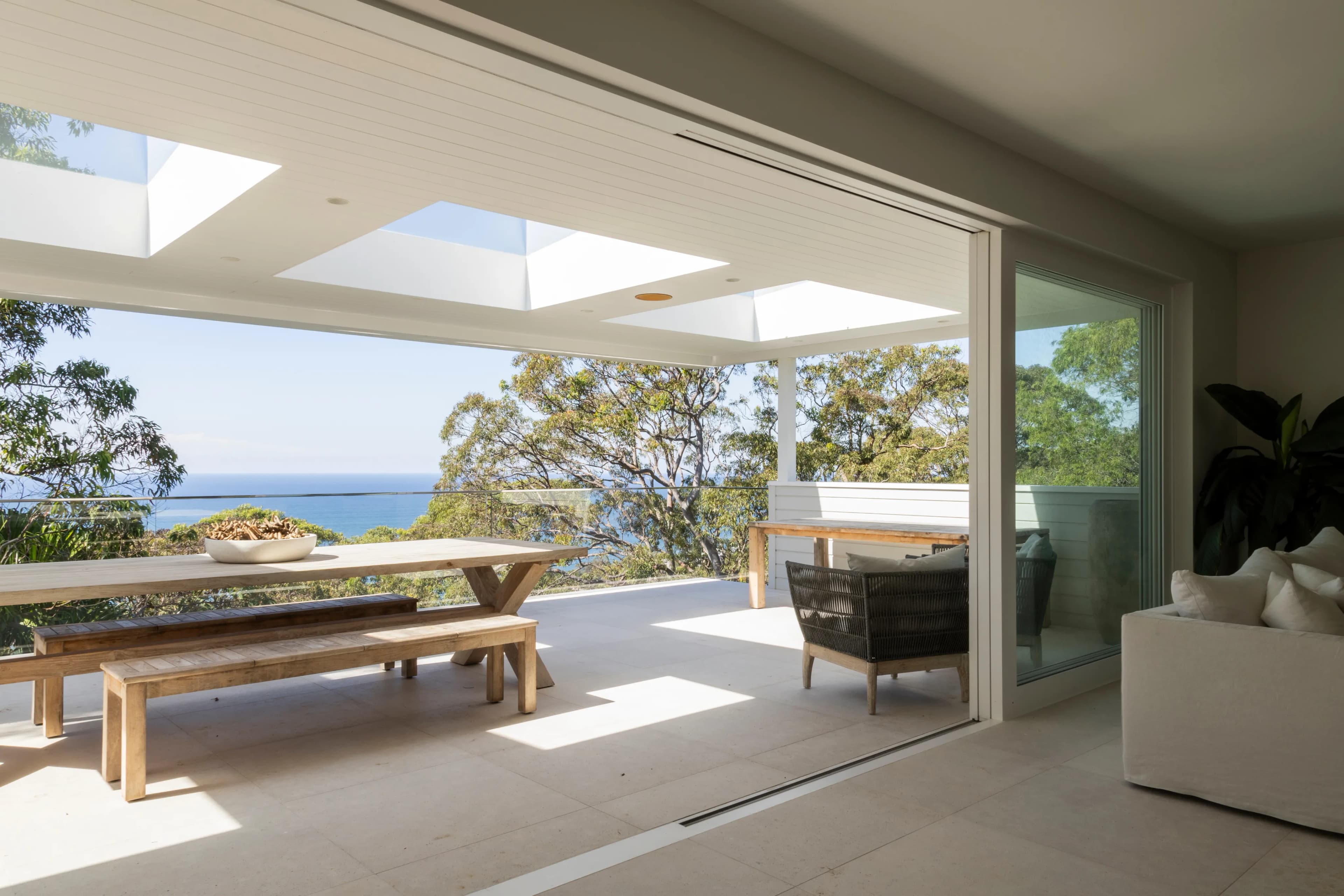
Capability · Coastal builds
Building for salt, wind, and the way Sydney's coast actually weathers.
Marine-grade fixings, salt-resistant finishes, cyclone-rated glazing, and the drainage strategy that decides whether a coastal home stays dry through a 1-in-20-year easterly.
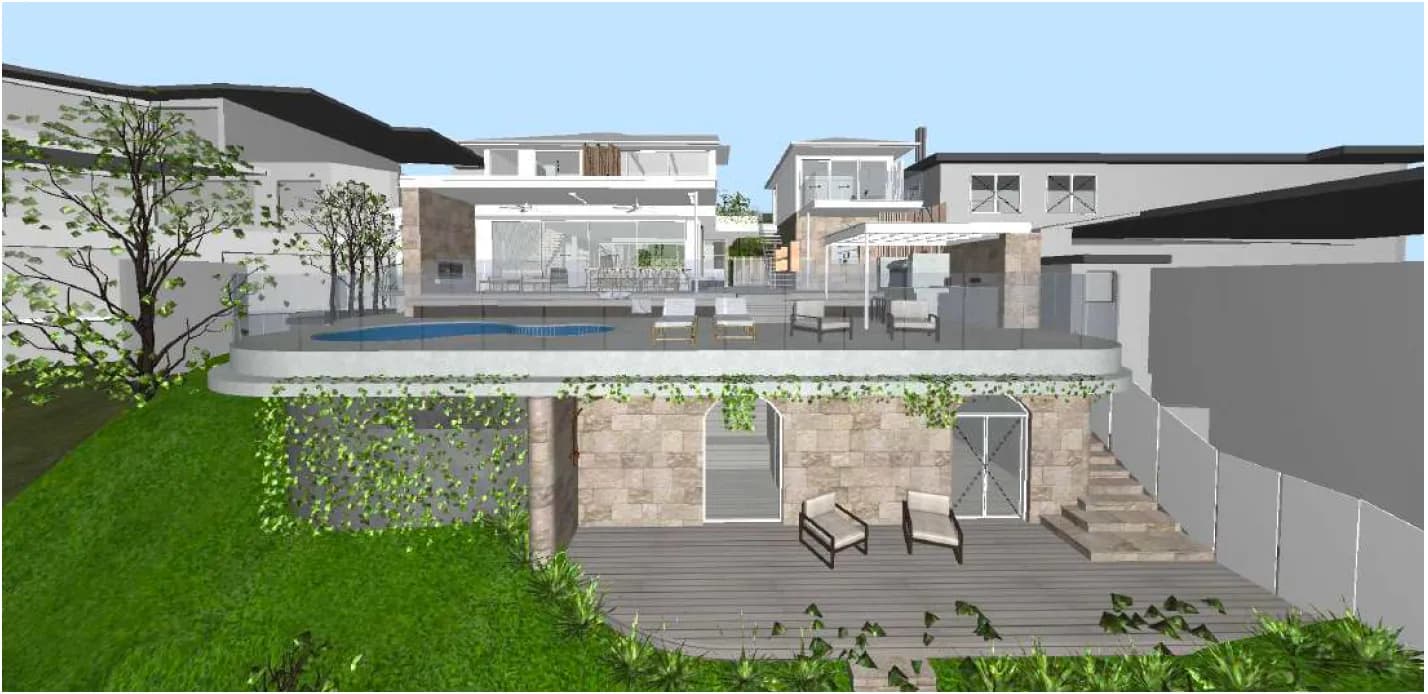
What's different about coastal builds
A house in Bilgola or Bronte is in a different physical environment than the same house in Strathfield. Salt-laden air corrodes anything not specified to marine grade. Easterlies drive horizontal rain into junctions a tested wall system was never qualified for. Sandy and clay soils behave differently under load, and groundwater is closer to the surface — sometimes within 1m of the slab in low-lying beachfront blocks. Coastal builds aren't harder — they're a different specification, and the most expensive errors happen when an inland-default spec gets dropped on a coastal site and the failure shows up two winters later as efflorescence, rust staining, or rotting trim.
AS 3600 exposure categories — what they mean for your spec
Australian Standard AS 3600 (Concrete Structures) classifies coastal exposure in three relevant bands. B1 — coastal but not surf-zone, more than ~1km from breaking surf. Standard durability concrete (typically 32 MPa, 30–40mm reinforcement cover). B2 — coastal, within 1km of the surf zone. Higher-grade concrete (typically 40 MPa, 45–50mm cover). C1 / C2 — within 100m of breaking surf, severe coastal exposure. 50 MPa concrete, 60–70mm cover, and stainless-steel reinforcement in critical structural elements. Most of Sydney's beachfront falls in B2 or C1; the headland and clifftop sites on the Northern Beaches and the Eastern Suburbs frequently sit in C1. Specifying B1 concrete on a C1 site is one of the most common (and most expensive to remediate) coastal-build errors in Sydney.
The materials that survive and the ones that don't
Stainless steel (316 marine grade, not 304) for all exposed structural fixings, balustrade systems, and pool surrounds. Hot-dip galvanised (HDG) is acceptable for non-critical exposed steel where the galvanising thickness is ≥85μm — Class B per AS/NZS 4680. Aluminium with marine-grade powder coat (Class 3, Interpon D2525 or equivalent) for window frames, gutters, and capping. Copper and zinc work well on roof flashings and exposed roofing where the look is wanted. Standard galvanised, chrome-plated fittings, and most carbon steel — all fail within 5–10 years on the coast. On timber: spotted gum, blackbutt, ironbark, and durability Class 1 species for external structural members and decking. Pine, even treated pine, doesn't last on exposed coastal applications without constant maintenance. On finishes: silicone-modified acrylic exterior paints (Dulux Weathershield Plus or similar) — and re-coat cycles every 5–7 years, not 10–12 like inland.
Drainage, water management, and the 1-in-100-year storm
Sydney's east-coast lows produce horizontal wind-driven rain that test-rigs for inland buildings never simulate. Roof falls need to be steeper than minimums (3.5° rather than 2° for low-slope roofs); flashings need to be deeper-lapped; gutter overflow protection needs to be designed for AS/NZS 3500 storm-event flows. Stormwater discharge has to handle the same loads — and for low-lying beachfront sites, the discharge path to the street drain needs to be hydraulically modelled because the public drain itself can be at capacity during the same event. Sub-floor and sub-slab drainage with sump-and-pump backup is standard on beachfront blocks where the static water table is within 2m of the slab.
Where coastal projects go wrong
Non-marine-grade fixings — the most common, most preventable failure. Carbon-steel reinforcement near the salt zone — corroded rebar will crack and spall concrete within 10 years on a C1 site. Aluminium window frames specified without coastal-grade powder coat — chalky white deterioration within 3 years. Roof junctions detailed for inland rain rather than horizontal wind-driven water — leaks at junctions during easterlies even when the roof field is fine. Decks built without proper drainage falls — pooled water, accelerated timber decay, and warranty calls. Each of these is a $5k–$30k forensic problem once it's built into the house, and trivial to specify correctly up front. The mistake is treating the BCA minimums as the coastal spec rather than as the inland floor.
How Varloch approaches coastal work
Coastal projects get a different specification book — not the same spec with a few notes added. Stainless or hot-dip galvanised fixings throughout, called out element-by-element. Marine-grade powder coat on all aluminium. Concrete grade and reinforcement cover specified to the actual AS 3600 exposure category, not the architect's first-draft default. Roof and wall junctions detailed for AS 4055 wind region, often with site-specific wind classifications above N3. And the director walks site weather events — not just dry-day inspections — because that's when you actually see whether the building envelope is doing its job. Maintenance handover includes a coastal-specific schedule with timber re-oiling intervals, paint re-coat triggers, and a fixing-inspection check.
Frequently asked
Do all my fixings need to be stainless?
Within roughly 1km of the coast, marine-grade 316 stainless or hot-dip galvanised (Class B, ≥85μm) is standard for structural and exposed fixings. Inside the building envelope, standard galvanised is usually fine. Your spec should list the exposure category by element — not as a blanket house-wide rule.
How far from the beach counts as 'coastal' for build purposes?
AS 4046 and AS 3600 use exposure classifications. Practically, anywhere within 1km of the open ocean is treated as coastal exposure (B2), and within 100m of breaking waves is severe coastal exposure (C1) with stricter requirements. Sites separated from the coast by a significant landform or dense urban buffer can sometimes be reclassified — but only with a defensible exposure assessment from the structural engineer.
Will my home need cyclone-rated glazing?
Sydney is generally outside the cyclone wind regions, but some clifftop and exposed coastal sites do require AS 1170.2 wind classifications above N3 — typically N4 or N5 on Bilgola, Whale Beach, Tamarama and similar exposed headlands. Get a site-specific wind report from a structural engineer before locking in glazing spec. Impact-resistant glazing (laminated rather than toughened) is a worthwhile spec on exposed elevations regardless of the wind classification.
Can I use timber on a beachfront home?
Yes — but specify durable species (spotted gum, blackbutt, ironbark — Class 1 durability) and treat junctions to manage salt and UV exposure. Avoid pine-based products in exposed external applications. Sub-frame and joist timbers in exposed deck construction should also be Class 1 or pressure-treated H4 hardwood — even though they're hidden, they fail first.
What's the maintenance cycle for a beachfront home?
Plan for paint re-coats every 5–7 years (not 10–12 like inland), timber re-oiling every 12–18 months on exposed surfaces, a coastal fixing inspection annually, and full roof and gutter clearance twice a year. We provide a maintenance schedule with handover that tracks all of these.
What about flood and coastal erosion overlays?
Many low-lying Sydney beachfront sites sit within Coastal Vulnerability Areas (CVAs) under the Coastal Management Act 2016, which can affect setbacks, finished floor levels, and consent pathways. Council DCPs in coastal LGAs (Northern Beaches, Randwick, Waverley, Woollahra) carry the specific controls. The DA needs to address the coastal hazard assessment directly.
Can I have a basement or pool on a beachfront block?
Yes, but expect dewatering during construction and likely a pumped drainage strategy for the life of the building. The pool itself needs to handle hydrostatic uplift when the water table rises during storms — which means either a heavily-reinforced shell, an empty-pool relief valve, or a pumped under-pool drainage system.
Working on something in this space?
Tell us about your site.
We do an initial conversation either over the phone or on site — your call. No deck, no sales pitch. Just a look at what you’re trying to do and an honest read on whether we’re the right team for it.
Builder of the Year
Australian Business Champions Awards
NSW · Residential construction